Over the past ten months, we have been building.
Quietly, deliberately, and with a strong bias toward execution. What began on the drawing board quickly turned into a full-stack effort covering hardware, software, operating procedures, and the many details required to make a robotic system work reliably in construction environments.
In under a year, we went from early concepts to servicing customers. During that time, we developed the entire technology stack in-house, designed and built the hardware platform, defined site-level SOPs, and benchmarked performance against real construction standards such as speed, consistency, quality of finish, and repeatability.
Construction has a way of humbling good ideas. Drawings change, schedules slip, materials show up late, and no two sites ever behave the same. A system that works only in controlled conditions rarely survives first contact with a live job site. From the beginning, we chose to learn where the work happens.
That perspective influenced every design decision. The focus was not on solving a single task in isolation, but on building a system that could operate within the flow of a job site. Layouts shift, trades overlap, access is constrained, and priorities change daily. Any technology meant to be useful in this environment has to adapt without slowing work down.
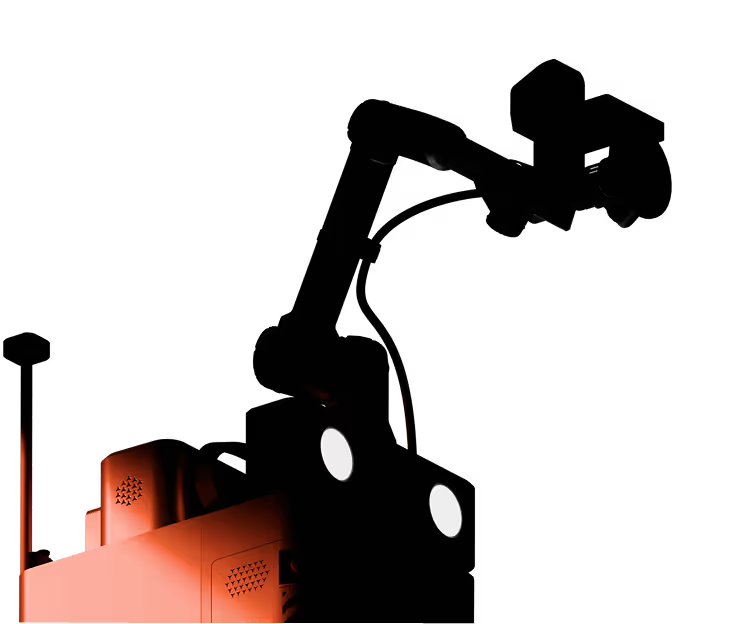
This led us to build Origin as a general-purpose robotic platform for construction. The system is modular, software-defined, and designed to support multiple trades across different phases of a project. Rather than being optimized for one narrow use case, it is built to stay productive as sites evolve.
Equally important was building the operational foundation around the technology. Reliable automation in construction depends as much on processes as it does on machines. Safety practices, maintenance routines, uptime expectations, and clear on-site workflows are what allow advanced systems to function consistently in the field.
As we come out of stealth, we do so with systems that are already in use, customers who are actively engaging with the platform, and a clearer understanding of what it takes to operate in real construction environments. There is still a long road ahead, but the fundamentals are in place.
We are excited to begin sharing more of what we are building at Origin, what we have learned so far, and how we think robotics can fit naturally into the way construction already works. This is the start of a longer journey, and we intend to build it carefully, collaboratively, and grounded in reality.